Posts tagged agent-runtime
-
After You Say ‘Fix This Bug’: How DeepSeek Harness Organizes Turns and Sessions
TL;DR: In DeepSeek Harness, a follow-up Input can wake the Agent Loop; a Turn is one continuous run that may contain several Steps, and each Step is one model request together with the Tools it asks to run. The Session Event Log records more than chat: it preserves execution boundaries, model-visible content, and action results. The Agent Loop is a Plugin that coordinates those Services in order, while persistence, resume, crash recovery, and fork all build on the same history.
-
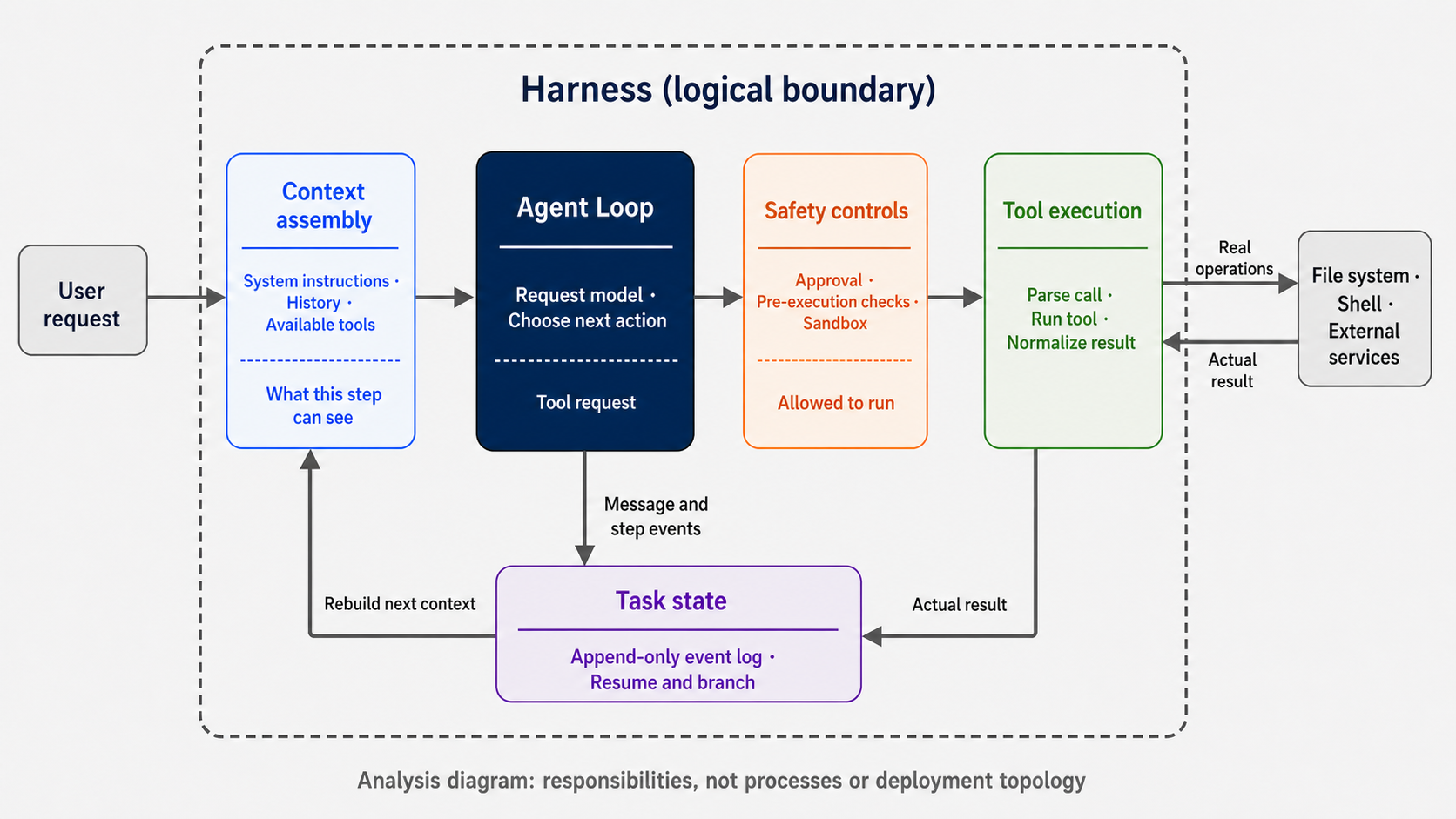
The Agent Loop Is Only the Beginning: What Does DeepSeek Harness Do Around the Model?
TL;DR: The Agent Loop explains how a model alternates between reasoning and tool calls. A Harness must also decide what the model sees, turn tool calls into real operations, preserve task progress, and stop unsafe actions before they reach the host system.
-
Codex Source Dive (I): the agentic loop is a runtime boundary
TLDR: A Codex turn is not one model call. It is a managed execution window where user input, tool calls, tool results, cancellation, compaction, and final answers are ordered by the runtime.
-
Codex Source Dive (II): goals are runtime state, not prompts
TLDR: A Codex Goal is a thread-level long-running task state machine. It stores objective, status, budget, usage, resume state, and continuation gates instead of relying on one remembered prompt.
-
Codex Source Dive (III): subagents are a thread tree
TLDR: A Codex subagent is not a background model call. It is a persistent child thread with identity, inherited runtime policy, forked context, mailbox communication, capacity limits, and resume behavior.
-
Dynamic Workflows: from prompt to runtime
Dynamic Workflows reframes long-horizon agent work as runtime synthesis: split context, externalize state, verify intermediate outputs, and let the harness carry the parts a single prompt cannot reliably hold.
-
Pi Agent: containerization and compaction
Coding agents need two boundaries at the same time: an execution boundary that controls what they can do, and a context boundary that controls what they can remember across long work.
-
Claude Code Source: an agent as an operating-system process
Reading Claude Code through an operating-system lens makes the agent runtime concrete: context preparation, tools, permissions, subprocesses, cancellation, compaction, plugins, and exit paths.