Crafting Interpreters (III): Resolving a Name Before It Runs
Crafting Interpreters (III): Resolving a Name Before It Runs
How the resolver gives each variable use a stable route
TLDR: Resolver freezes variable identity before execution. Each variable-use node gets either a fixed local depth or a deliberate global lookup, so mutable closure environments can keep changing without changing what the source-level binding means.
Episode II made the tree run. Expressions produced values, statements made effects, environments stored names, function calls created fresh environments, and closures let one of those environments survive after the call that created it had returned.
That solved a lifetime question. It did not yet solve a binding question.
Start with a program that is small enough to distrust:
var a = "global";

{
  fun showA() {
    print a;
  }

  showA();
  var a = "block";
  showA();
}
There is only one print a; in the source. The variable a is never assigned. Under Lox’s lexical rule, that one variable use should keep the same declaration throughout execution, so the expected output is:
global
global
But the interpreter we had after closures can print:
global
block
Give the variable expression inside showA() a label:
U_a = the Expr.Variable("a") node inside print aThe same AST node ran twice and changed its mind. That is the bug.
Technical promise: by the end of this episode, you should be able to follow one variable expression from source text to Resolver.scopes, from there to Interpreter.locals, and finally to getAt() or globals.get(), explaining why the repaired interpreter prints global twice without making environments immutable.
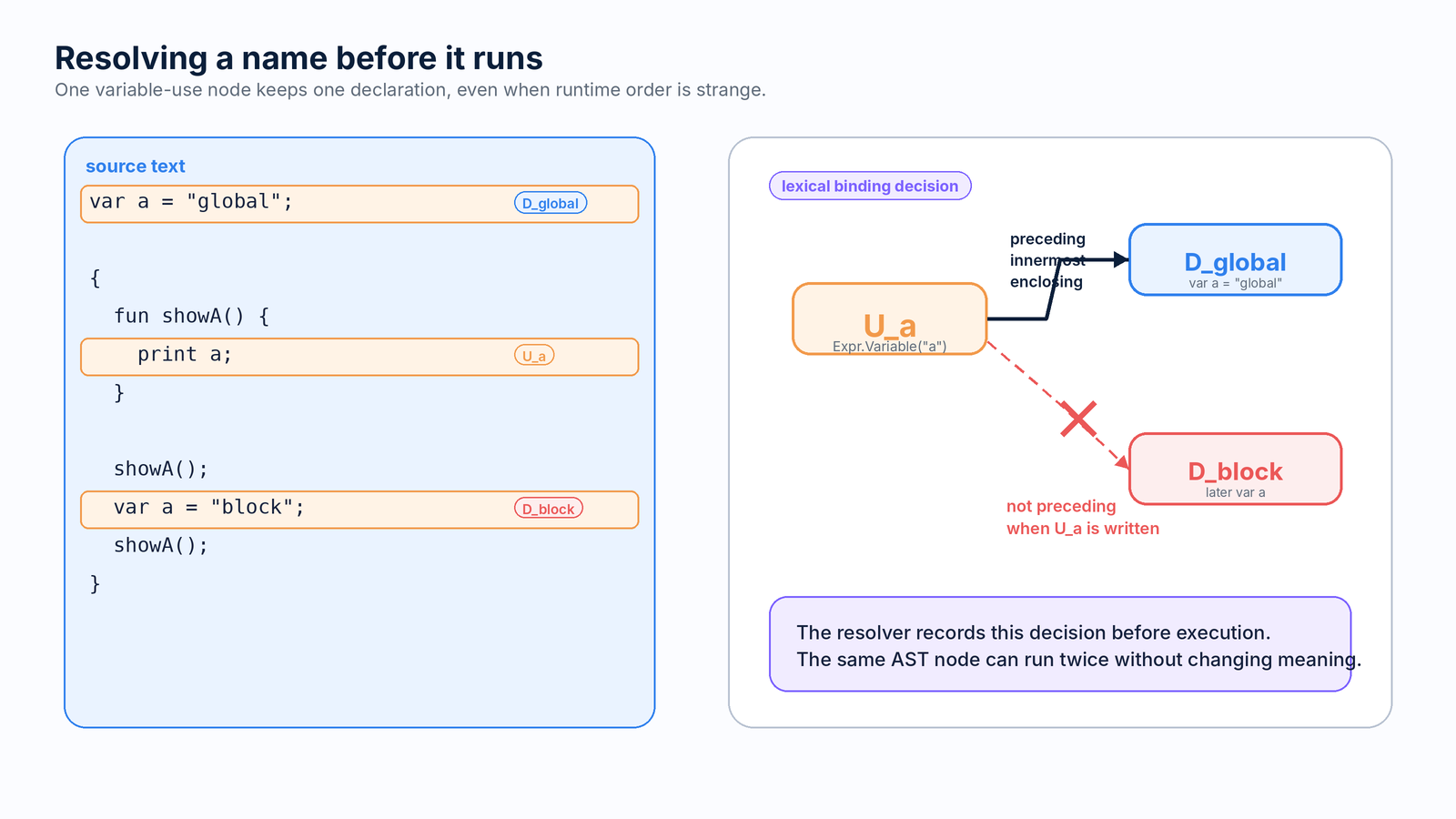
Figure 1. The source-level binding of U_a is decided before execution. The later block declaration is visible in runtime time, but not in the source position where U_a appears.
1. The rule belongs to the text, not to time
Lox uses lexical scope. A variable use can be resolved by looking at the program text, not by waiting to see how execution happens.
The rule from Chapter 11 is the one sentence this entire episode depends on:
A variable usage refers to the preceding declaration with the same name in the innermost scope that encloses the expression where the variable is used.
Three words do the work.
Preceding means the declaration must appear before the use in the source text. In the opening program, the global declaration is before U_a:
var a = "global"; // D_globalThe block declaration is after the function body containing U_a:
fun showA() {
  print a; // U_a
}

var a = "block"; // D_block
The function body executes later, but its text is already written. Runtime delay does not move the source position of print a;.
Innermost handles shadowing:
var a = "outer";
{
  var a = "inner";
  print a; // inner
}
Both declarations precede the use, but the block declaration is in the innermost enclosing scope, so it wins.
Enclosing limits the search to scopes that wrap the expression. A declaration somewhere else in the file is not a candidate just because it has the same spelling.
This rule is static. It does not mention environments, function calls, hash tables, or mutation. A variable expression can execute many times, but its declaration should not be re-chosen each time.
Our interpreter currently performs name lookup dynamically. Most of the time, the dynamic search happens to agree with the static rule. Closures expose the gap.
2. The closure remembered a mutable environment
At runtime, the opening program passes through three important states.
First, the global declaration creates a global entry:
global env
  a = "global"
Then the block begins, creating a block environment. When the interpreter executes the function declaration, it creates a LoxFunction. That function stores the declaration node and the current environment as its closure.
block env  # object B
  showA = <fn showA, closure → object B>
  enclosing → global env

global env
  a = "global"
The phrase object B matters. The closure does not store a frozen copy of the block. It stores a reference to the same mutable Environment object used by the block.
Now the first call runs:
showA();Calling showA creates a fresh call environment whose parent is the function’s closure:
showA call env
  enclosing → object B

object B
  showA = <fn showA>
  enclosing → global env

global env
  a = "global"
The old interpreter looks up a by walking the current environment chain:
call env: no a
object B: no a
global: a = "global"
So the first call prints:
globalThen this declaration executes:
var a = "block";It does not create a second block environment. It inserts a new entry into the same object B:
object B
  showA = <fn showA, closure → object B>
  a = "block"
  enclosing → global env
The second call creates another empty call environment, again enclosing object B. If lookup asks the runtime chain, “Who is a today?”, it now gets a different answer:
call env: no a
object B: a = "block"
The closure did not forget anything. The environment it remembered grew a new entry.
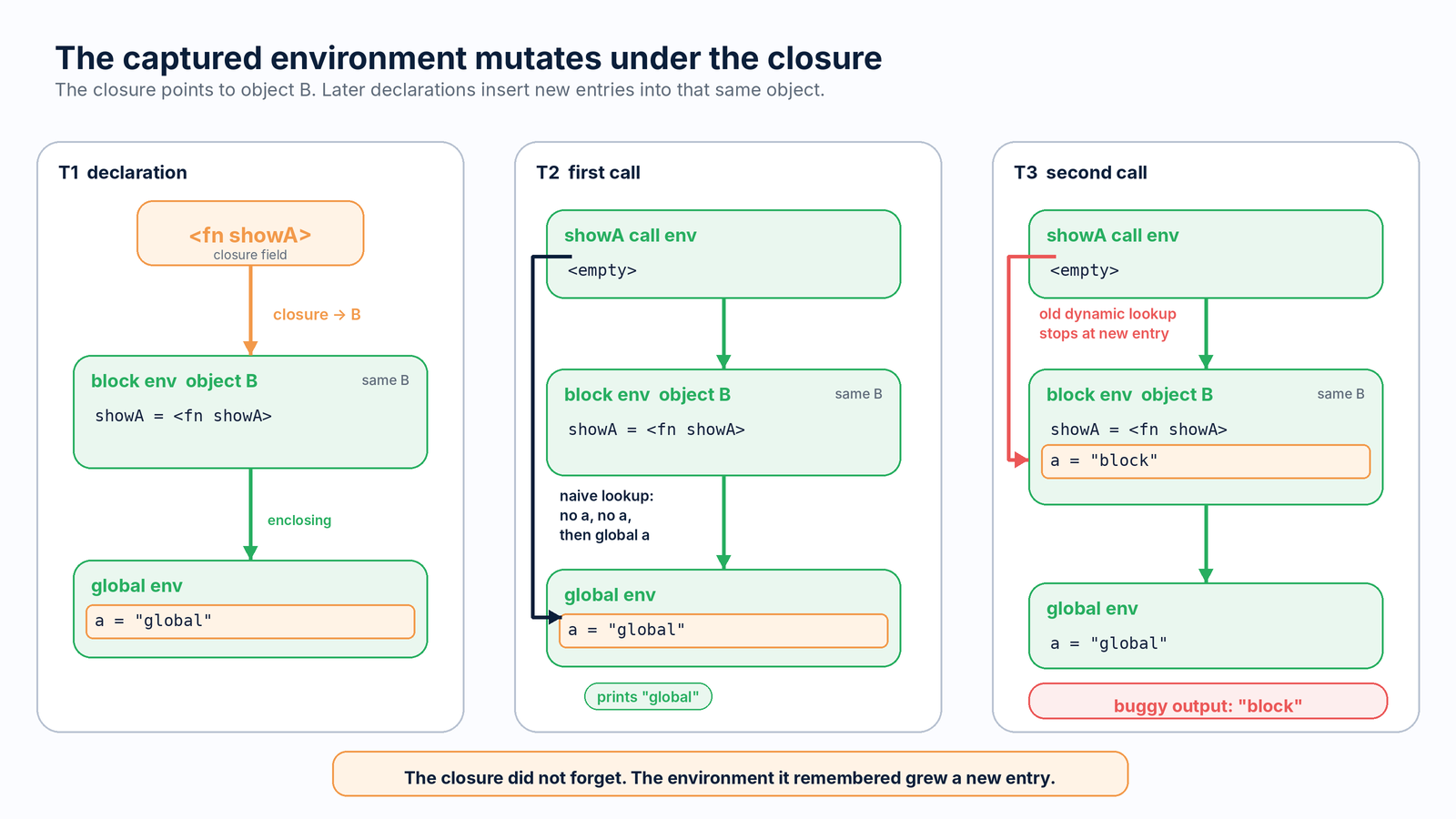
Figure 2. The bug is not that showA failed to capture an environment. It captured a mutable environment object that later received a new binding.
The fix could have been persistent, immutable environments. Each declaration would create a new environment object, and a closure would keep the old one. That would work, but it would rewrite a lot of jlox.
The book chooses the smaller and more useful fix: keep environments as they are, but stop re-solving local names by searching mutable runtime chains.
3. The resolver is a notebook, not an environment
The new mechanism is a pass between parsing and interpretation:
Resolver resolver = new Resolver(interpreter);
resolver.resolve(statements);

interpreter.interpret(statements);
The resolver walks the AST once before execution. It does not run user code. It does not print. It does not call functions. It does not execute loops repeatedly. It visits the structure of the program to answer one static question:
For this variable use, which declaration does the source text choose?A useful way to keep the moving parts separate:
| Name | Stores | Exists when | Answers |
|---|---|---|---|
| AST | statements and expressions | after parsing | where does this use appear? |
Resolver.scopes | name → declared/defined | during resolution | is this name visible here in the source? |
Environment.values | name → runtime value | during interpretation | what value does this name have now? |
Interpreter.locals | Expr node → depth | after resolution, used at runtime | how many environment links should this use follow? |
The resolver’s scope stack is not a runtime environment. It does not store runtime values like "global", "block", 40, or true. It stores whether a name is visible at the current source position.
In jlox, the field is:
private final Stack<Map<String, Boolean>> scopes = new Stack<>();The Boolean distinguishes two declaration states:
false  declared, but not ready to read
true   defined, ready to read
That split catches a confusing initializer:
var a = "outer";

{
  var a = a;
}
For a local variable, the resolver first declares the name, then resolves the initializer, then defines the name:
declare(stmt.name);
resolve(stmt.initializer);
define(stmt.name);
During the initializer, the local a exists in the resolver map but is marked false. If the initializer tries to read that same local variable, the resolver reports an error. This is declaration state, not runtime state. No Lox value is needed to detect the problem.
Now trace the opening program through the resolver.
var a = "global";

{
  fun showA() {
    print a;
  }

  showA();
  var a = "block";
  showA();
}
At top level, global variables are not recorded in Resolver.scopes, so after var a = "global"; the local scope stack is still empty.
Entering the block pushes one local scope:
scopes = [
  {}
]
Resolving the function declaration adds showA to that block scope:
scopes = [
  { showA: true }
]
Then the resolver enters the function body. It pushes a function scope for parameters and locals:
scopes = [
  { showA: true },
  {}
]
Now it reaches the important node:
print a; // U_aThe resolver searches from the innermost local scope outward:
function scope: no a
block scope:    no a
No local declaration is found. Since globals are not tracked in the local stack, the resolver leaves this expression absent from Interpreter.locals.
Interpreter.locals[U_a] = absentAbsent does not mean forgotten. It means:
At runtime, look in globals.Only after resolving U_a does the resolver later reach:
var a = "block";Then the block scope becomes:
scopes = [
  { showA: true, a: true }
]
Source time has already passed U_a. The later block a cannot retroactively become the declaration for a variable expression that appeared earlier in the function body.
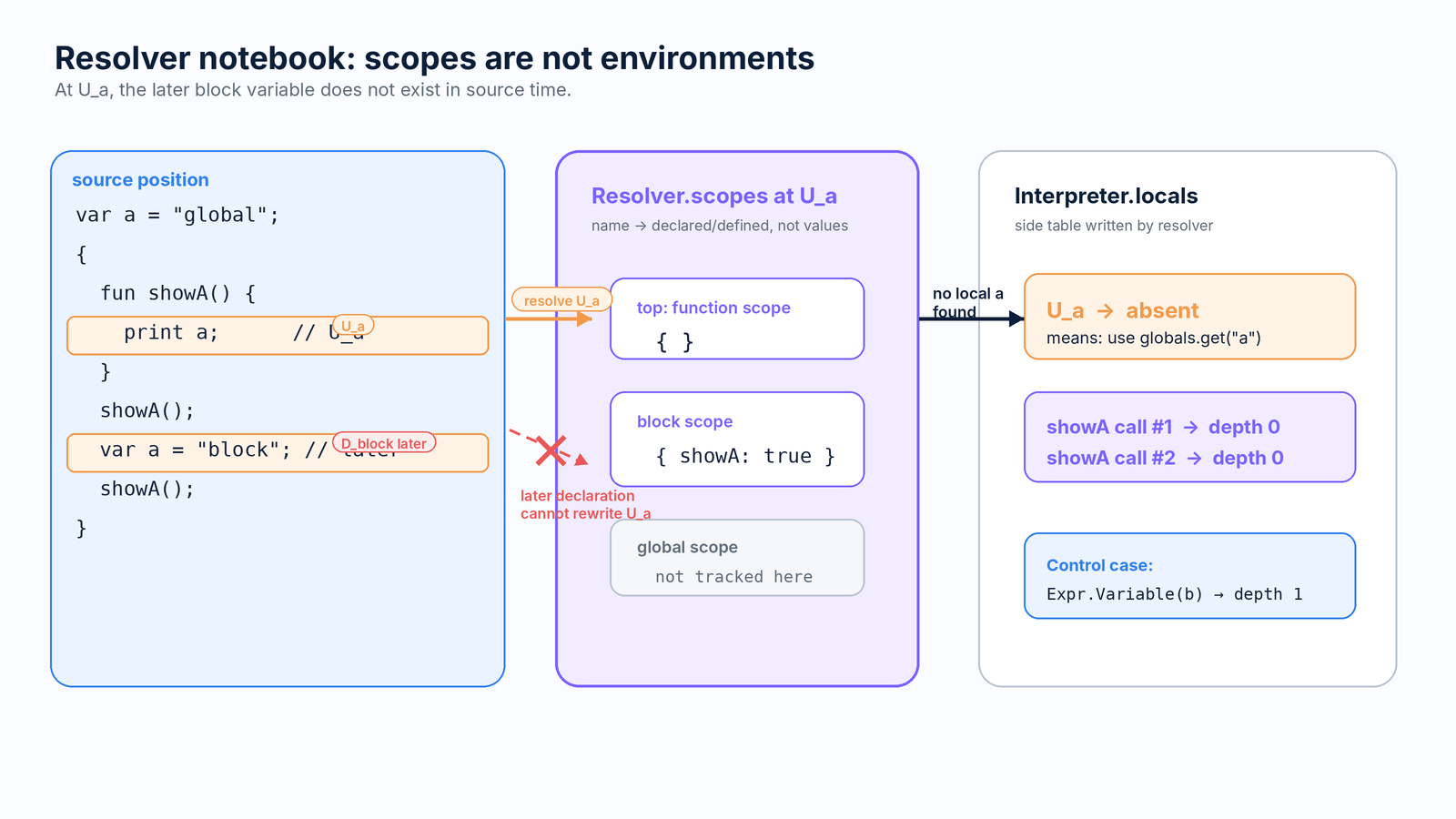
Figure 3. While resolving U_a, the resolver can see showA in the block scope, but not the later block a. No local depth is recorded, so runtime global lookup is intentional.
4. Depth turns a binding into a route
The opening bug is the global case, so U_a has no local depth. To see the positive case, use a local that really is found:
{
  var b = "outer";

  fun f() {
    print b;
  }

  f();
}
When the resolver reaches print b, the scope stack looks like this:
scopes = [
  { b: true, f: true },
  {}
]
The top scope is the function body. The next one is the surrounding block.
The resolver searches from inside out:
function scope: no b
block scope:    b found
The declaration is one scope outside the current one, so the resolver records:
Interpreter.locals[U_b] = 1The implementation is compact:
private void resolveLocal(Expr expr, Token name) {
  for (int i = scopes.size() - 1; i >= 0; i--) {
    if (scopes.get(i).containsKey(name.lexeme)) {
      interpreter.resolve(expr, scopes.size() - 1 - i);
      return;
    }
  }
}
The distance is the number of enclosing-scope hops from the current innermost scope to the scope where the name was found. Current scope is depth 0. Immediately enclosing scope is depth 1. One more level out is depth 2.
The resolver hands that number to the interpreter:
void resolve(Expr expr, int depth) {
  locals.put(expr, depth);
}
The interpreter stores it in a side table:
private final Map<Expr, Integer> locals = new HashMap<>();The key is the expression node, not the variable name string.
That matters here:
var a = "global";

{
  var a = "block";
  print a; // U_inner
}

print a;   // U_global
Both variable expressions use the lexeme "a". They do not have the same binding.
The table is not:
"a" → one answerIt is:
U_inner  → depth 0
U_global → absent, global
Each Expr.Variable object has identity. The side table attaches resolved data to that exact node.
5. Runtime lookup follows the route instead of searching
Before the resolver, variable lookup treated the environment chain as a search problem:
environment.get(name)
  try current
  try enclosing
  try enclosing.enclosing
  ...
After resolution, local lookup becomes indexed access:
lookUpVariable(name, expr)
  find this expression's distance
  if distance exists:
      getAt(distance, name)
  else:
      globals.get(name)
The interpreter code becomes:
private Object lookUpVariable(Token name, Expr expr) {
  Integer distance = locals.get(expr);

  if (distance != null) {
    return environment.getAt(distance, name.lexeme);
  } else {
    return globals.get(name);
  }
}
For local variables, Environment gets a fixed-hop accessor:
Object getAt(int distance, String name) {
  return ancestor(distance).values.get(name);
}

Environment ancestor(int distance) {
  Environment environment = this;
  for (int i = 0; i < distance; i++) {
    environment = environment.enclosing;
  }
  return environment;
}
Assignments use the same route:
void assignAt(int distance, Token name, Object value) {
  ancestor(distance).values.put(name.lexeme, value);
}
This does not replace environments. The runtime still uses a chain of Environment objects. The difference is that a resolved local no longer asks, “Where is the nearest matching name today?” It already knows which link to jump to.
Now replay the second showA() call after the block declaration has executed:
showA call env
  enclosing → block env

block env
  showA = <fn showA>
  a = "block"
  enclosing → global env

global env
  a = "global"
The tempting block a exists at runtime. But the variable expression inside showA has this resolution:
locals.get(U_a) = nullSo the interpreter does not call:
environment.get("a")It calls:
globals.get("a")The result is:
globalThe block environment still mutates. The closure still points to it. The fix is that U_a no longer asks that environment whether it has an a.
The resolver does not freeze environments. It freezes lookup decisions.
6. Return to makeCounter: identity meets lifetime
Now return to the series program:
fun makeCounter(start) {
  var n = start;

  fun tick() {
    n = n + 1;
    return n;
  }

  return tick;
}

var counter = makeCounter(40);
print counter(); // 41
Episode II explained why n can survive. When tick is declared, the LoxFunction for tick captures the current environment: the call environment for makeCounter. When makeCounter returns, the Java call is gone, but the returned function still points to that environment.
That is lifetime.
Episode III explains identity.
During resolution, the resolver enters makeCounter’s function scope and binds the parameter:
makeCounter scope:
  start: true
Then it resolves:
var n = start;n is declared, the initializer start resolves to depth 0, and then n is defined:
makeCounter scope:
  start: true
  n: true
Then the resolver reaches the nested function:
fun tick() {
  n = n + 1;
  return n;
}
It declares and defines tick in the makeCounter scope, then enters a new function scope for the body of tick:
scopes = [
  { start: true, n: true, tick: true },
  {}
]
Inside tick, every use of n searches outward:
tick scope:        no n
makeCounter scope: n found
So each n inside tick receives depth 1:
Expr.Assign(n in n = ...)       → 1
Expr.Variable(n in n + 1)       → 1
Expr.Variable(n in return n)    → 1
At runtime, after makeCounter(40) returns, the retained environment looks like:
global
  counter → <fn tick>
               closure
                 ↓
              makeCounter call env
                start = 40
                n = 40
                tick = <fn tick>
When counter() runs, the call environment for tick encloses the captured makeCounter environment:
tick call env
  enclosing → makeCounter call env
                  n = 40
The assignment uses the resolved route:
getAt(1, "n")      → 40
assignAt(1, "n")   → 41
getAt(1, "n")      → 41
Then return n; returns 41.
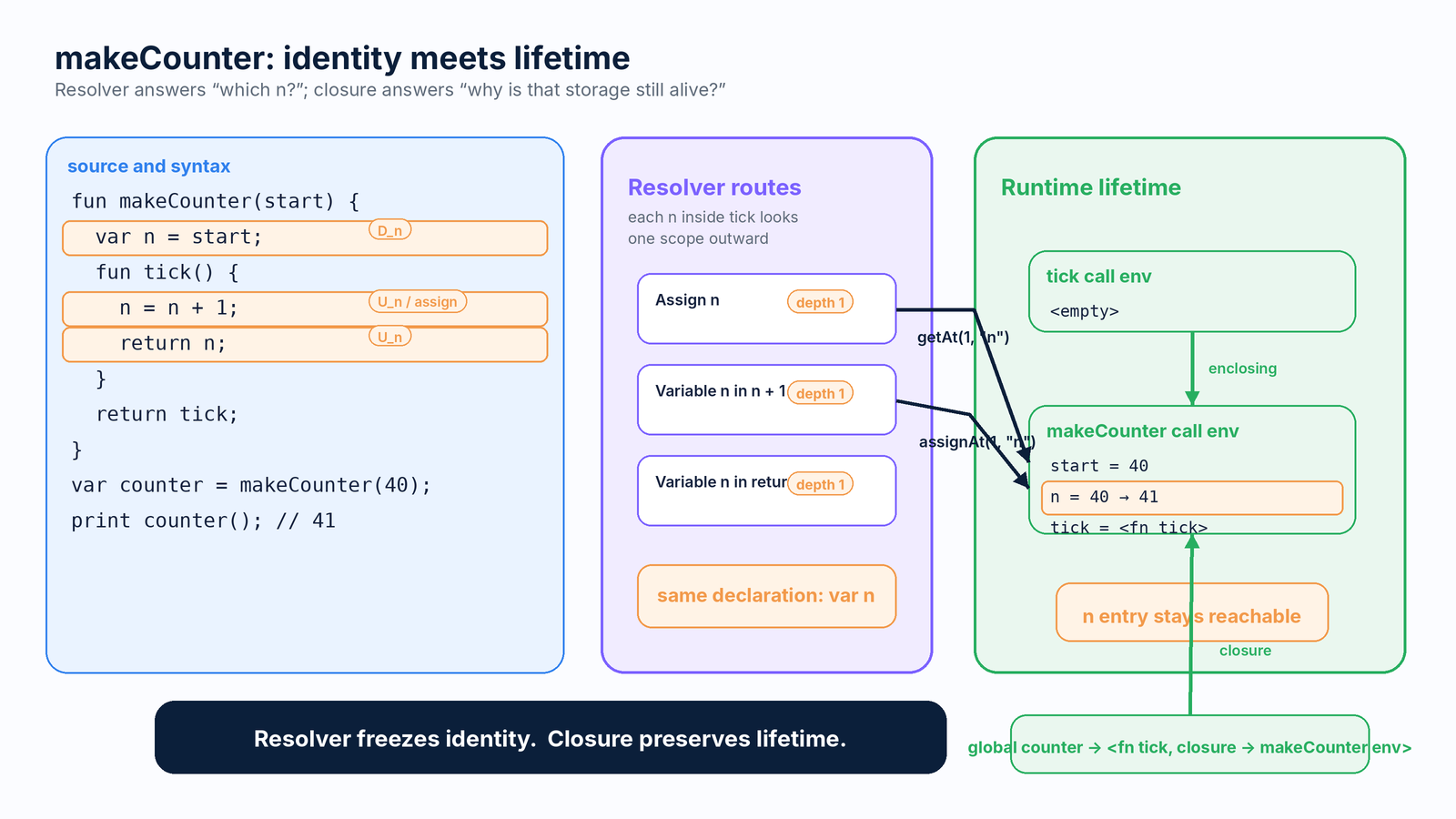
Figure 4. The resolver gives each n inside tick a depth of 1. The closure keeps the environment at that depth reachable after makeCounter returns.
So where is n now?
source text        var n = start;
variable uses      each n inside tick
lexical binding    those uses refer to makeCounter's n
resolver route     Expr → depth 1
runtime storage    makeCounter call environment
lifetime reason    tick's closure keeps that environment reachable
The resolver answers:
Which declaration is this n?The closure answers:
Why is that declaration's storage still alive?Keeping those questions separate makes closures much less magical.
7. Static errors are a bonus, not the main fix
Once the interpreter has a semantic pass, it can also reject some impossible states before runtime.
We already saw one:
var a = "outer";

{
  var a = a;
}
Inside the initializer, the local a exists in the resolver’s current scope map but is marked false, so the resolver reports:
Can't read local variable in its own initializer.Another example is duplicate local declarations:
fun bad() {
  var a = "first";
  var a = "second";
}
The resolver can see that the current local scope already contains a, so it reports a static error.
A third example is top-level return:
return "at top level";The runtime Return exception only makes sense inside a function call. The resolver tracks whether it is currently inside a function and rejects a return statement outside one.
These checks are useful, but they are not the core of this episode. The central job is still name identity: each variable use should carry a stable route from source meaning to runtime storage.
That same idea will matter again when this appears. this looks like a variable expression, but it is only meaningful inside methods. The resolver is the right place to know that.
8. Re-run the bug: the binding edge is fixed
Return to the opening program:
var a = "global";

{
  fun showA() {
    print a;
  }

  showA();
  var a = "block";
  showA();
}
After resolution, the interesting table is:
U_a inside showA       → absent from locals → global
first showA callee     → depth 0
second showA callee    → depth 0
When the first call runs:
U_a:
  locals.get(U_a) = null
  globals.get("a") = "global"
When the block-local declaration runs, the block environment becomes:
block env
  showA = <fn showA>
  a = "block"
When the second call runs:
U_a:
  locals.get(U_a) = null
  globals.get("a") = "global"
So the output is:
global
global
The same AST node executed twice. The runtime environment changed between the two executions. The binding did not.
Checkpoint:
Environment stores values.
Closure preserves environments.
Resolver records name identity.
Interpreter.locals stores routes.
getAt() and assignAt() follow those routes.
The broader lesson is small but durable:
Runtime containers are allowed to change. Source-level relationships that must not change need their own representation.
Source map
Primary source:
- Robert Nystrom, Crafting Interpreters, Chapter 11, “Resolving and Binding”: static scope, the
showA()closure-scope bug, mutable environments, the resolver pass,Resolver.scopes,declare()/define(),resolveLocal(),Interpreter.locals,lookUpVariable(),getAt(),assignAt(), and running the resolver before interpretation. - Robert Nystrom, Crafting Interpreters, Chapter 12, “Classes”: the next episode’s bridge to
this, methods, andLoxFunction.bind().
Implementation entry points:
Resolver.java
  visitBlockStmt()
  visitVarStmt()
  visitVariableExpr()
  visitAssignExpr()
  visitFunctionStmt()
  resolveFunction()
  beginScope()
  endScope()
  declare()
  define()
  resolveLocal()

Interpreter.java
  locals
  resolve()
  visitVariableExpr()
  lookUpVariable()
  visitAssignExpr()

Environment.java
  get()
  assign()
  getAt()
  assignAt()
  ancestor()

Lox.java
  run()
  Resolver resolver = new Resolver(interpreter)
  resolver.resolve(statements)
  interpreter.interpret(statements)
Previous episode:
- Crafting Interpreters (II): The Tree Begins to Run: runtime values, environments, function call environments, closure capture, and the leftover binding mystery.
Bridge to Episode IV
Episode III fixed ordinary variable identity. A variable expression now carries a stable route from source meaning to runtime storage.
Episode IV moves that pressure into objects:
class Counter {
  init(start) {
    this.n = start;
  }

  tick() {
    this.n = this.n + 1;
    return this.n;
  }
}
Now n is no longer a lexical local variable. It is a field reached through this.
That changes the question. The receiver this is lexical, but the field name n is looked up on an instance at runtime. When a method is pulled off an object and called later, the method still needs to remember which instance supplied this.
So Episode IV asks a new version of the same question:
A local variable needed a stable declaration. What does a method need so that
this.nstill finds the right object later?