Crafting Interpreters (II): The Tree Begins to Run
Crafting Interpreters (II): The Tree Begins to Run
How executable structure becomes values, effects, state, control flow, calls, and closures
TL;DR: An AST does not run itself. The interpreter walks the tree, turns expression nodes into runtime values, uses statements to create effects, stores names in chained environments, changes traversal through control flow, and lets functions carry environments as closures.
Episode I stopped with source text turned into executable structure. The parser had chosen a tree, but the tree was still inert. Literal(2) was syntax that could produce a value later; it was not yet a value moving through a program.
Episode II begins at that boundary. The question is no longer:
How does source text become a tree?
The question is:
How does that tree become a run?
We will trace one small report program. It is deliberately plain: Lox does not automatically concatenate strings and numbers, so labels and numeric values print on separate lines.
fun row(day, amount) {
  print "day";
  print day;
  print "amount";
  print amount;
  return amount;
}

fun makeTotal(start) {
  var sum = start;

  fun add(amount) {
    sum = sum + amount;
    return sum;
  }

  return add;
}

var running = makeTotal(0);
var total = 0;

for (var day = 1; day <= 3; day = day + 1) {
  var amount = day * 10;
  total = running(row(day, amount));
}

if (total >= 60 and total < 100) {
  print "status";
  print "ok";
} else {
  print "status";
  print "review";
}

print "total";
print total;
The output is:
day
1
amount
10
day
2
amount
20
day
3
amount
30
status
ok
total
60
The whole runtime question is hidden in one line:
total = running(row(day, amount));When this line runs, which expression produces which value, which statement changes which state, which environment stores each name, which nodes run next, and why does the hidden sum survive after makeTotal() has returned?
The complete journey is compact enough to write as a chain:
AST → values → effects → environments → control flow → calls → closuresEach arrow resolves a different uncertainty. Expressions produce values. Statements make those values observable or durable. Environments give names a runtime home. Control flow changes which subtrees are visited. Function calls create new execution boundaries. Closures let some of those boundaries outlive the call that created them.
The same questions appear in larger languages. C and Rust have expression order, block scopes, function call frames, and returns. JavaScript and Python make closures part of daily programming. Lox keeps the model small enough that we can watch each piece move.
Technical promise: by the end of this article, you should be able to trace total = running(row(day, amount)); through expression evaluation, argument evaluation, function calls, parameter binding, return unwinding, assignment, environment lookup, loop desugaring, and closure capture.
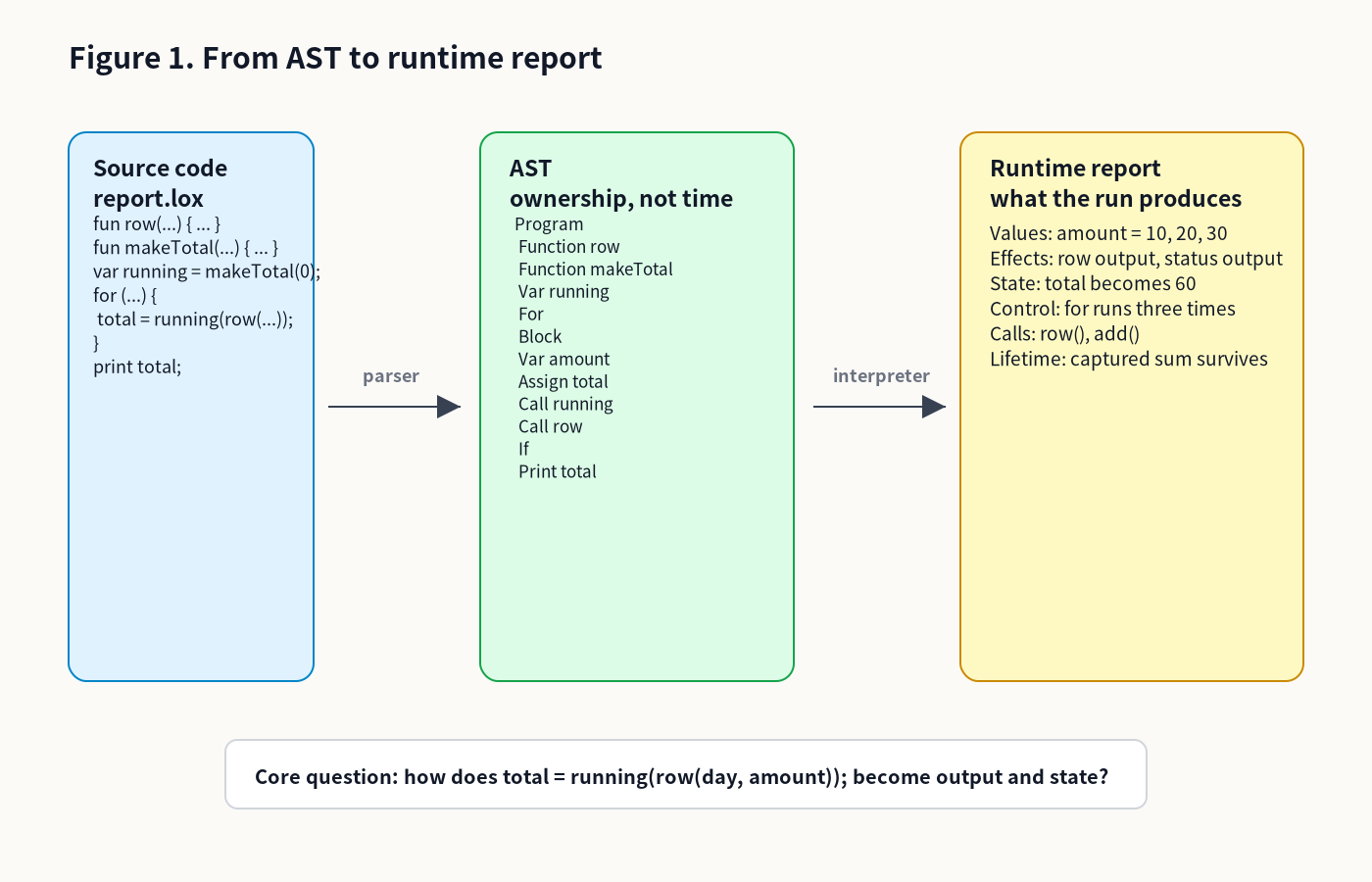
Figure 1. Episode I produced the tree. Episode II asks how the interpreter turns that tree into a runtime report.
1. The AST remembers ownership; the interpreter creates time
At the top level, a Lox program is a list of statements. Our report begins with two function declarations, then two variable declarations, then a loop, a branch, and two final prints.
That gives one simple rule:
Top-level statements execute in order unless control flow changes the path.Inside those statements, the interpreter keeps switching between two verbs:
private Object evaluate(Expr expr) {
  return expr.accept(this);
}

private void execute(Stmt stmt) {
  stmt.accept(this);
}
evaluate(expr) runs an expression and returns a Lox value. execute(stmt) runs a statement and performs an effect. The distinction matters because the tree contains both kinds of nodes. A binary expression asks, “What value do I produce?” A print statement asks, “What action do I perform?”
Now focus on the loop body:
var amount = day * 10;
total = running(row(day, amount));
The second line is an expression statement whose expression is an assignment. The assignment cannot change total until the right-hand side has produced a value. The right-hand side is a call:
running(row(day, amount))That call contains another call as its argument:
Call running
  argument:
    Call row
      argument: day
      argument: amount
So the tree fixes ownership: row(day, amount) is an argument to running(...); running(...) is the right-hand side of total = ...; the assignment is inside the loop body.
The interpreter supplies time:
evaluate assignment
  evaluate right-hand side: running(row(day, amount))
    evaluate callee: running
    evaluate argument: row(day, amount)
      evaluate callee: row
      evaluate argument: day
      evaluate argument: amount
      call row
        print "day"
        print day
        print "amount"
        print amount
        return amount
    call running
      update captured sum
      return new sum
  assign returned value to total
This is the runtime equivalent of Episode I’s parsing trace. In the first episode, the parser’s call stack temporarily remembered which grammar rule was waiting for which subtree. Here, the interpreter’s Java call stack temporarily remembers which runtime operation is waiting for which value.
The tree is static. The traversal happens at runtime.
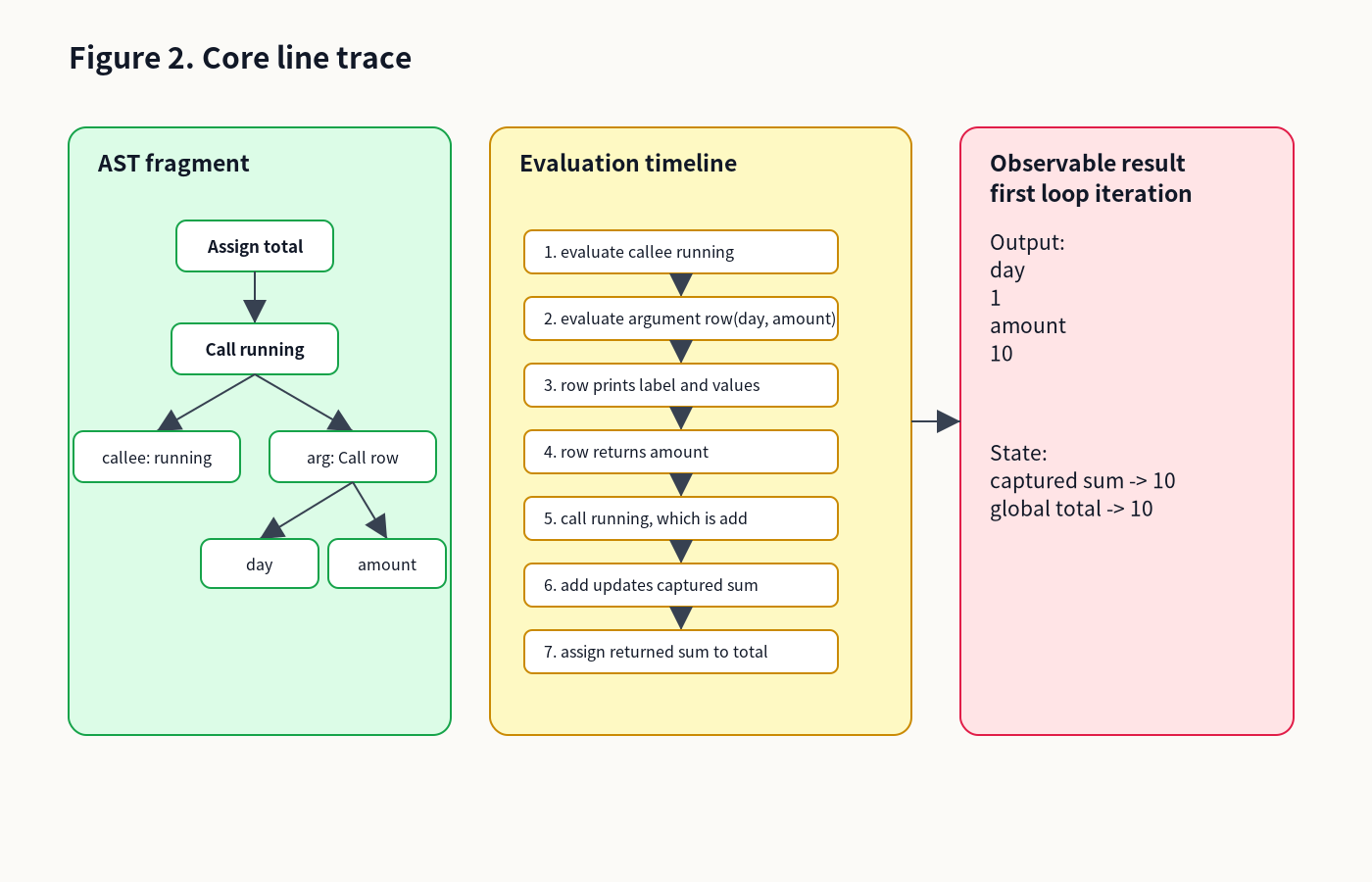
Figure 2. The AST says which expression owns which child. The interpreter decides when those children are evaluated and when side effects happen.
For the rest of the article, we will keep returning to this line. Each section adds one missing piece of its execution.
2. Expressions produce runtime values
When a child expression returns, it does not return syntax. It returns a runtime value.
In jlox, the first user-visible values are represented with ordinary Java objects:
Lox number  -> Java Double
Lox string  -> Java String
Lox bool    -> Java Boolean
Lox nil     -> Java null
The loop creates amount with a binary expression:
var amount = day * 10;The parser has already built a Binary node. The interpreter now evaluates the left child, evaluates the right child, and applies the operator rule:
public Object visitBinaryExpr(Expr.Binary expr) {
  Object left = evaluate(expr.left);
  Object right = evaluate(expr.right);

  switch (expr.operator.type) {
    case PLUS:
      if (left instanceof Double && right instanceof Double) {
        return (double)left + (double)right;
      }
      if (left instanceof String && right instanceof String) {
        return (String)left + (String)right;
      }
      throw new RuntimeError(expr.operator,
          "Operands must be two numbers or two strings.");

    case STAR:
      checkNumberOperands(expr.operator, left, right);
      return (double)left * (double)right;
  }

  return null;
}
For day * 10, the left side is the current value of day, and the right side is the numeric literal 10. * requires two numbers, so the three iterations produce:
day = 1 -> amount = 10
day = 2 -> amount = 20
day = 3 -> amount = 30
That is runtime semantics. The AST says, “This is a binary expression with a STAR token.” The interpreter says, “Evaluate both operands. Check that both values are numbers. Multiply them.”
The same pattern handles +, but Lox gives + two legal meanings:
print 1 + 2;     // 3
print "a" + "b"; // ab
print "1" + 2;   // runtime error
The third line matters. Lox does not convert the number into a string. In the book implementation, + accepts either two numbers or two strings. Mixed operands are a runtime error, and the error carries the operator token so the interpreter can report the source location of the bad operation.
Comparison operators are stricter. <, <=, >, and >= require numbers and produce Booleans:
print 3 < 4;     // true
print "a" < "b"; // runtime error
Equality is looser in a different way. Different kinds of values can be compared, but Lox does not implicitly convert between them:
print nil == nil;   // true
print 3 == "3";     // false
print false != nil; // true
Truthiness is another runtime law. It appears in !, if, while, and, and or:
Only false and nil are falsey.
Everything else is truthy.
So both 0 and "" are truthy in Lox.
This directly affects the report status check:
if (total >= 60 and total < 100) {
  print "status";
  print "ok";
} else {
  print "status";
  print "review";
}
After the loop, total >= 60 evaluates to true. Because the operator is and, the interpreter then evaluates total < 100, which also evaluates to true. The condition is truthy, so the then branch runs.
A variable expression is syntax. A number, string, Boolean, nil, or function object is runtime data. The interpreter’s first job is to turn the former into the latter.
3. Statements turn values into effects
A report needs more than one value. It has output, and it has state that changes over time.
The first two top-level statements are function declarations:
fun row(day, amount) { ... }
fun makeTotal(start) { ... }
Executing a function declaration does not run the function body. It creates a callable runtime object and stores it under the function name:
global
  row       -> <fn row>
  makeTotal -> <fn makeTotal>
Then the program declares variables:
var running = makeTotal(0);
var total = 0;
A variable declaration evaluates its initializer first, then defines the name in the current environment. makeTotal(0) returns the inner add function, so the global environment becomes:
global
  row       -> <fn row>
  makeTotal -> <fn makeTotal>
  running  -> <fn add>
  total    -> 0
The AST represents source structure, so it should not store the current value of total. Runtime state belongs in environments.
Inside the loop, assignment changes that state:
total = running(row(day, amount));Assignment is an expression. It evaluates the right-hand side, then stores the resulting value in an existing variable.
Across the three iterations, the effect is:
day 1: row returns 10, running returns 10, total becomes 10
day 2: row returns 20, running returns 30, total becomes 30
day 3: row returns 30, running returns 60, total becomes 60
The line does not merely compute 60. It makes total remember 60 so later statements can use it.
A compact summary:
expression statement: evaluate, then discard the result
print statement:      evaluate, then expose the result
var declaration:      evaluate initializer, then define a name
assignment:           evaluate new value, then mutate an existing name
The core idea is:
Expressions produce values. Statements turn values into effects. Environments let those effects persist across statements.
That is the beginning of the runtime model. Names and values do not live inside the syntax tree. They live in a changing store that the interpreter carries while it walks the tree.
4. Environments give state a boundary
One global environment fails as soon as local variables appear. The report loop has one:
for (var day = 1; day <= 3; day = day + 1) {
  var amount = day * 10;
  total = running(row(day, amount));
}
amount should exist only inside the loop body. It should not become global or survive after that body finishes. Blocks create those temporary worlds.
A block environment points to the environment that was current before the block began:
loop body block
  amount -> 10
  ↓ enclosing
for block
  day -> 1
  ↓ enclosing
global
  total -> 0
  running -> <fn add>
Lookup starts in the current environment and walks outward. Assignment walks the same chain, but mutates the environment where the name was found:
Object get(Token name) {
  if (values.containsKey(name.lexeme)) return values.get(name.lexeme);
  if (enclosing != null) return enclosing.get(name);
  throw new RuntimeError(name, "Undefined variable.");
}

void assign(Token name, Object value) {
  if (values.containsKey(name.lexeme)) {
    values.put(name.lexeme, value);
    return;
  }
  if (enclosing != null) {
    enclosing.assign(name, value);
    return;
  }
  throw new RuntimeError(name, "Undefined variable.");
}
That rule explains the loop body. amount is defined in the body block. day is found one environment outward. total is found in global and mutated there.
The interpreter enters a block by temporarily swapping the current environment:
void executeBlock(List<Stmt> statements, Environment environment) {
  Environment previous = this.environment;
  try {
    this.environment = environment;
    for (Stmt statement : statements) execute(statement);
  } finally {
    this.environment = previous;
  }
}
The finally is essential. A block may finish normally, or a runtime error may escape it, or a return signal may pass through it. In every case, the interpreter must restore the previous environment. Otherwise, a local scope would leak into the rest of the program.
This is the runtime counterpart of block scope in languages with { ... }. A local world can see outward, but when control leaves that world, its local names stop being current.
The report now has layered state:
global
  row       -> <fn row>
  makeTotal -> <fn makeTotal>
  running  -> <fn add>
  total    -> 0 / 10 / 30 / 60

for block
  day      -> 1 / 2 / 3 / 4

loop body block
  amount   -> 10 / 20 / 30
State is no longer one flat map. It has boundaries, and those boundaries are part of execution.
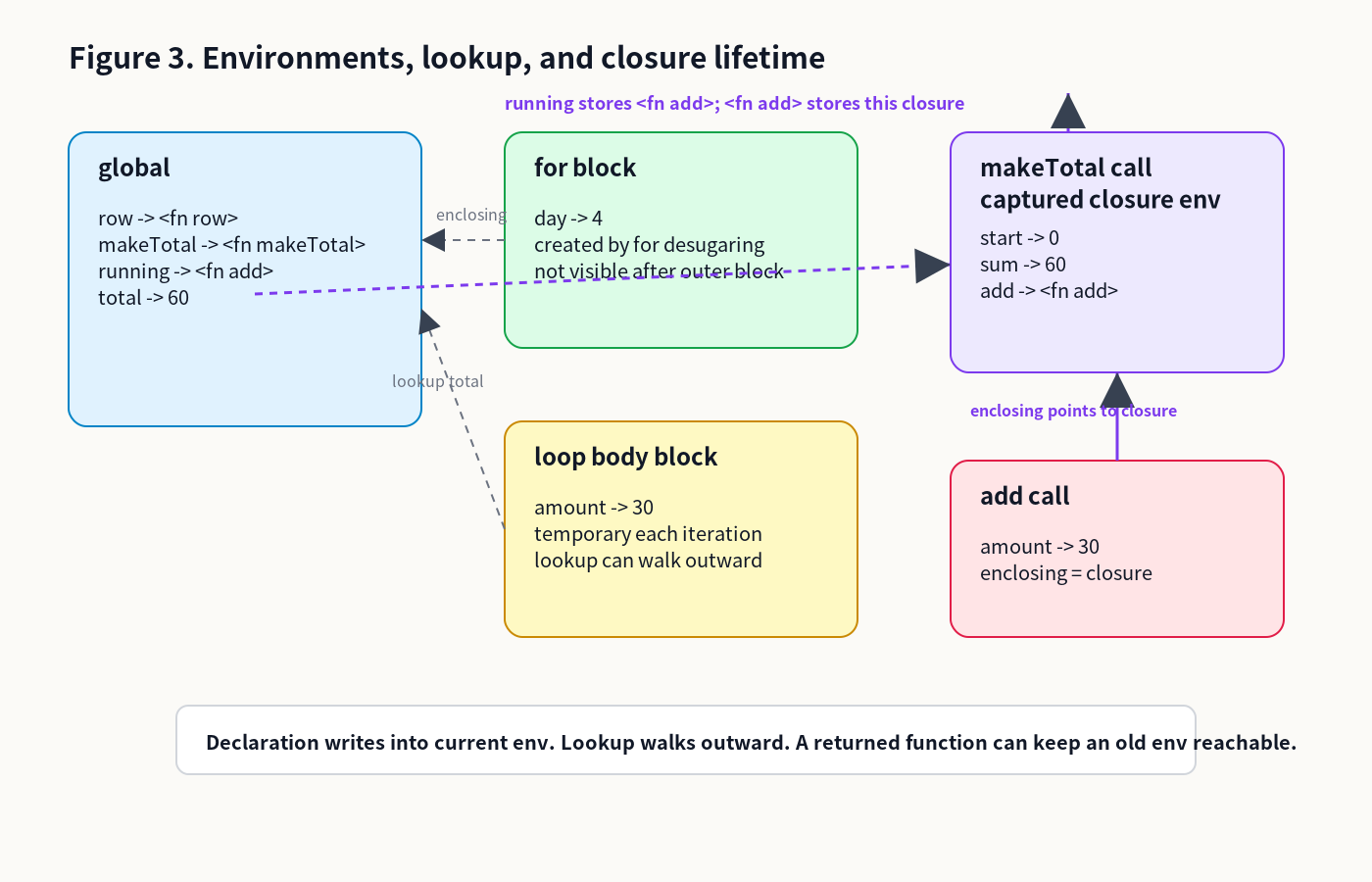
Figure 3. Declarations write into the current environment. Lookup walks outward. Closures can keep an older environment reachable.
5. Control flow changes which subtree runs next
If the interpreter visited every child node exactly once, it could evaluate arithmetic and execute straight-line statements. It could not run a report that loops and branches.
Control flow changes the traversal path.
An if statement evaluates its condition first. If the condition is truthy, the then branch runs. Otherwise, the else branch runs, if present.
Logical operators do the same kind of selection inside expressions. For and, the interpreter evaluates the left operand first. If that value is falsey, the right operand is skipped. For or, if the left operand is truthy, the right operand is skipped.
So the AST may contain a child that does not run.
A while loop repeats a child subtree:
while condition is truthy:
  execute body
The condition is evaluated before every iteration, including the first. The body may run zero times, one time, or many times.
The most revealing control-flow feature here is for, because jlox does not add a new runtime visitor for it. The parser lowers for into older nodes.
Our source loop is:
for (var day = 1; day <= 3; day = day + 1) {
  var amount = day * 10;
  total = running(row(day, amount));
}
The parser separates four pieces:
initializer: var day = 1
condition:   day <= 3
increment:   day = day + 1
body:        the block that computes amount and updates total
Then it constructs an equivalent tree:
{
  var day = 1;

  while (day <= 3) {
    {
      var amount = day * 10;
      total = running(row(day, amount));
    }

    day = day + 1;
  }
}
The order matters:
1. Append the increment after the original body.
2. Use the condition as the while condition.
3. Put the initializer before the while.
4. Wrap initializer and while in an outer block.
That outer block gives day the right lifetime. It is visible to the condition, the body, and the increment, but it does not leak outside the loop.
The execution becomes:
define day = 1
evaluate day <= 3 -> true
  define amount = 10
  run row, update running sum, assign total = 10
  increment day to 2
evaluate day <= 3 -> true
  define amount = 20
  run row, update running sum, assign total = 30
  increment day to 3
evaluate day <= 3 -> true
  define amount = 30
  run row, update running sum, assign total = 60
  increment day to 4
evaluate day <= 3 -> false
exit loop
The parser does more than recognize a for loop. It chooses a smaller runtime vocabulary for the interpreter. This is desugaring: a surface feature borrows existing runtime semantics.
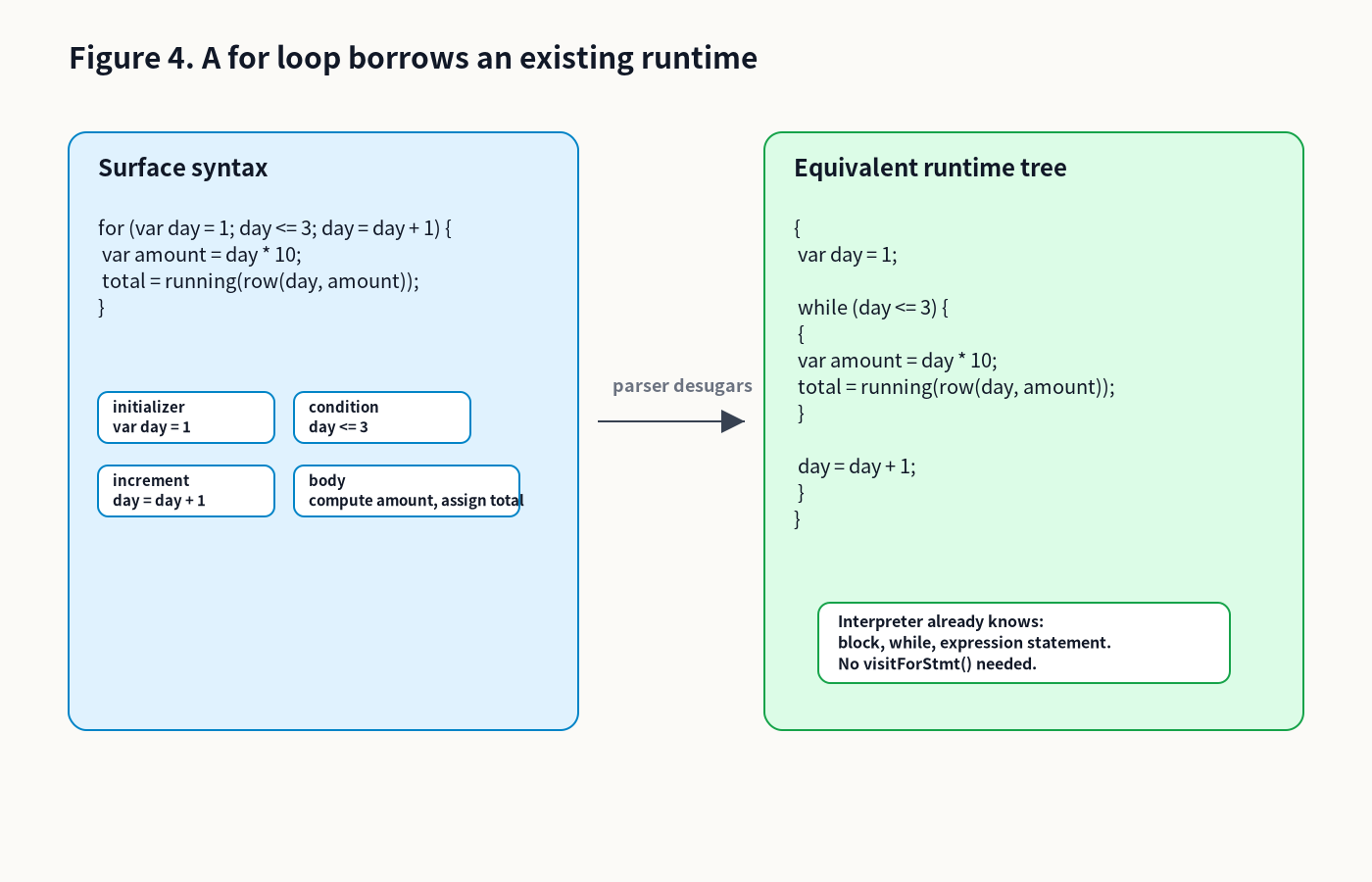
Figure 4. for reuses block, while, and expression-statement execution instead of adding a separate runtime mechanism.
6. Function calls create new execution boundaries
A function declaration stores code for later. A function call creates a new runtime world now.
Both row and makeTotal are declared at top level, so each function object is stored in global. But their bodies do not run at declaration time.
A callable answers two runtime questions:
arity(): how many arguments do you expect?
call():  what happens when those arguments arrive?
For a user-defined function, call() creates an environment, binds parameters, executes the body, and returns a value:
public Object call(Interpreter interpreter, List<Object> arguments) {
  Environment environment = new Environment(closure);

  for (int i = 0; i < declaration.params.size(); i++) {
    environment.define(declaration.params.get(i).lexeme,
        arguments.get(i));
  }

  try {
    interpreter.executeBlock(declaration.body, environment);
  } catch (Return returnValue) {
    return returnValue.value;
  }

  return null;
}
When the loop evaluates:
row(day, amount)it first evaluates the callee, then evaluates the arguments left to right, then calls the function. The call environment looks like:
row call
  day    -> 1
  amount -> 10
  ↓ enclosing
global
  row -> <fn row>
Then the body runs:
print "day";
print day;
print "amount";
print amount;
return amount;
The first four statements produce output. The final statement returns the number that will become the argument to running(...).
Each call gets a fresh environment:
row call #1: day -> 1, amount -> 10
row call #2: day -> 2, amount -> 20
row call #3: day -> 3, amount -> 30
That is why parameters are local to one call. The declaration is shared, but the parameter environment is not.
return is the first construct in this episode that deliberately crosses several visitor calls. A return may appear inside blocks, branches, or loops. When it runs, the interpreter must jump back to the function-call boundary, skipping whatever nested execution is still active.
jlox implements that jump with a small internal exception:
class Return extends RuntimeException {
  final Object value;

  Return(Object value) {
    super(null, null, false, false);
    this.value = value;
  }
}
Users never see this as a runtime error. Inside the interpreter, it is a control signal. Executing return amount; evaluates amount, wraps the value in Return, and throws it. LoxFunction.call() catches the signal and turns the stored value into the value of the call expression.
In the report line, this lets row(day, amount) behave as both an effect and a value: it prints the row, then returns the numeric amount to the surrounding call.
7. Closures let an environment outlive its call
Now focus on the accumulator:
fun makeTotal(start) {
  var sum = start;

  fun add(amount) {
    sum = sum + amount;
    return sum;
  }

  return add;
}

var running = makeTotal(0);
At top level, makeTotal is stored as a function whose closure is global:
global
  makeTotal -> <fn makeTotal, closure = global>
Calling makeTotal(0) creates a fresh call environment:
makeTotal call
  start -> 0
  ↓ enclosing
global
Then var sum = start; defines sum in that call environment:
makeTotal call
  start -> 0
  sum   -> 0
  ↓ enclosing
global
Now the nested declaration runs:
fun add(amount) {
  sum = sum + amount;
  return sum;
}
A function object stores more than code. It stores the environment that was current when the function was declared.
So add stores:
declaration: the add function body
closure:     the makeTotal call environment
The call environment now contains:
makeTotal call
  start -> 0
  sum   -> 0
  add   -> <fn add, closure = this environment>
  ↓ enclosing
global
Finally, return add; sends that function object back to the top level, and running stores it:
global
  running -> <fn add>
The Java call stack no longer contains makeTotal(0). The function body has finished. The interpreter’s current environment is global again.
But the makeTotal call environment is not gone:
global
  running -> <fn add>
               closure
                 ↓
              makeTotal call
                start -> 0
                sum   -> 0
                add   -> <fn add>
This is the first time a runtime environment outlives the call that created it.
A block environment usually stops being current when the block finishes. A function call environment usually stops being current when the call returns. But a closure can keep a function call environment reachable.
That is the lifetime twist of Chapter 10.
Now compare the two functions in the report:
row is declared at top level:
  row call
    day -> 1
    amount -> 10
    ↓ enclosing
  global

add is declared inside makeTotal:
  add call
    amount -> 10
    ↓ enclosing
  makeTotal call
    sum -> 0
    ↓ enclosing
  global
Both are LoxFunction objects. The difference is the closure stored in the function object. A function call environment’s enclosing pointer is initialized from the function object’s closure.
That one detail explains the running total:
before loop:
  captured sum = 0

day 1:
  row returns 10
  add updates sum = 0 + 10
  captured sum = 10
  global total = 10

day 2:
  row returns 20
  add updates sum = 10 + 20
  captured sum = 30
  global total = 30

day 3:
  row returns 30
  add updates sum = 30 + 30
  captured sum = 60
  global total = 60
The global variable total stores the latest returned value. The closure stored in running keeps the hidden sum alive between calls.
8. The line has become a run
Return to the concrete question:
total = running(row(day, amount));We can now answer it precisely.
The AST says row(day, amount) is an argument to running(...). The interpreter evaluates that argument before calling running.
Calling row creates a fresh call environment. Its parameters receive the current day and amount. Its body prints the row and returns amount.
Calling running creates another fresh call environment. But running is the returned add function, so this call environment encloses the captured makeTotal environment, not the loop body. Inside that captured environment, sum is found and updated.
The return value from running becomes the right-hand-side value of the assignment. Assignment then walks outward from the current environment until it finds total in global, and mutates that entry.
The same line runs three times because the parser lowered the for loop into a block plus a while, and the while condition remains truthy for day = 1, 2, and 3.
After the loop, the branch condition runs:
total >= 60 and total < 100The left comparison is true. and therefore evaluates the right comparison. That is true too, so the then branch prints:
status
ok
Finally, the last two print statements expose the stored result:
total
60
The whole program output is therefore:
day
1
amount
10
day
2
amount
20
day
3
amount
30
status
ok
total
60
What began as a tree has become a report.
The interpreter did not do this in one leap. It added runtime meaning layer by layer:
Expressions produce values.
Operators enforce laws on those values.
Statements turn values into effects.
Environments preserve those effects as state.
Blocks give state local boundaries.
Control flow changes which subtrees run.
Functions create fresh execution contexts.
Return jumps back to the function-call boundary.
Closures let a function carry an environment after its original call has ended.
That is the spine of Chapters 7-10.
Runtime model checkpoint
By this point, the reader should be able to explain the runtime model in five groups.
Values:
1. Expression nodes produce runtime values.
2. Binary expressions evaluate children before applying an operator.
3. Lox's + accepts two numbers or two strings, but not a mixed pair.
4. Only false and nil are falsey.
Effects and state:
5. Statements create visible or persistent effects.
6. Environments store names and values outside the AST.
7. Assignment mutates the environment where a name is found.
Boundaries:
8. Blocks create temporary environments.
9. Function calls create fresh parameter environments.
10. executeBlock() restores the previous environment even when control exits early.
Control:
11. if, while, and short-circuit logic change which subtrees run.
12. for reuses block and while through parser-side desugaring.
13. return is an internal non-local control signal.
Lifetime:
14. A function object stores a declaration plus a closure environment.
15. A returned function can keep a local environment alive.
16. Captured state can be updated across later calls.
These small pieces are the moving parts behind familiar language features: expressions, variables, scopes, loops, calls, returns, and closures.
Lox keeps the machinery small enough that we can watch every moving part.
Source map
The book remains the primary source for this episode:
- Chapter 7, “Evaluating Expressions”: runtime values, expression visitors, arithmetic, comparison, equality, truthiness, and runtime errors.
- Chapter 8, “Statements and State”: statements,
print, variable declarations, assignment, environments, and blocks. - Chapter 9, “Control Flow”:
if, logical operators,while, andfordesugaring. - Chapter 10, “Functions”: callable objects, arity, function declarations, call environments,
return, and closures.
Useful implementation entry points:
Interpreter.java:evaluate(),execute(), expression visitors, statement visitors,executeBlock(),visitCallExpr(),visitLogicalExpr(), andvisitReturnStmt().Environment.java:define(),get(),assign(), and theenclosinglink.Parser.java: theforStatement()desugaring into block andwhilenodes.LoxCallable.java: thearity()andcall()protocol.LoxFunction.java: function objects, parameter binding, call environments, closure capture, and return handling.Return.java: the internal control signal used to leave a function body.
Bridge to Episode III
At the end of this episode, running keeps a sum alive:
global
  running -> <fn add>
               closure
                 ↓
              makeTotal call
                sum -> 60
That solves the lifetime mystery:
How can a local variable survive after its function returns?
It survives because the returned function still points to the environment where the variable was declared.
But it opens a binding mystery:
When the interpreter later sees the name
sum, how does it know which declaration that name is supposed to mean?
So far, lookup walks environment chains at runtime. That works for the report program. But closures make one uncomfortable fact visible: environments are mutable objects, and the program can keep references to them.
Episode III begins there. The tree now runs. Next, each variable expression needs a stable binding.