Concordia: LLM agents as social simulation actors
The one-line read
Concordia is not just a way to make several LLM agents talk. It is a platform for putting language agents inside a social world that has roles, memory, institutions, local observations, and state changes.
That distinction matters. A chat swarm is mostly conversation. Concordia is closer to a small social laboratory.
Agent and Game Master
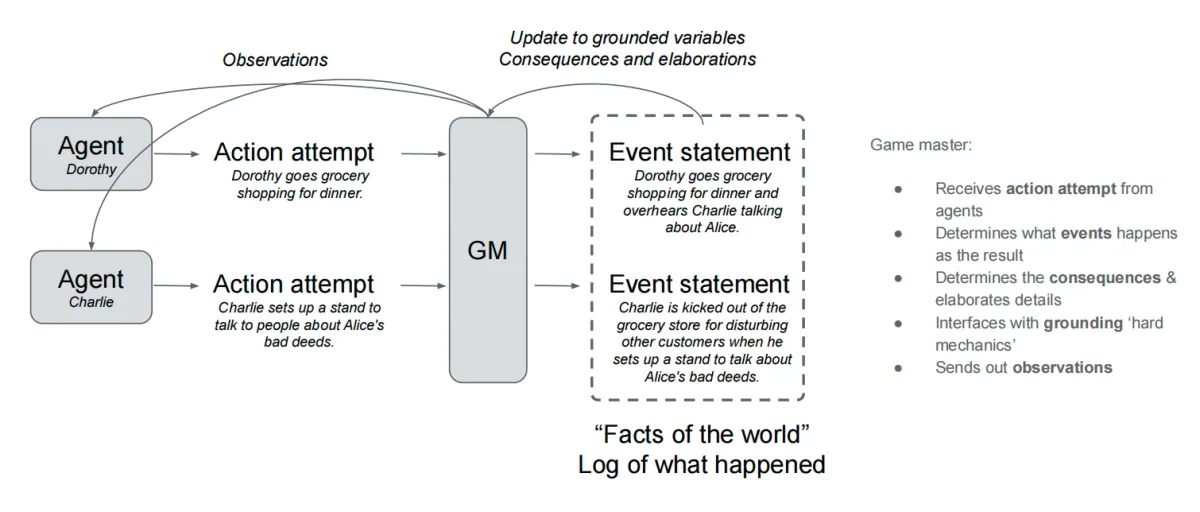
The core architecture has two layers:
| Layer | Responsibility |
|---|---|
| Agent | Generates situated intentions from identity, memory, goals, and observations |
| Game Master | Maintains the world, judges actions, updates grounded variables, and emits observations |
The agent does not directly mutate the world. It proposes an action in natural language:
Alice wants to schedule a meeting with Bob tomorrow at 4pm.
Charlie wants to warn customers about Alice near the grocery store.
The Game Master decides what actually happens. It can translate the action into a calendar event, reject it as impossible, update money or location, or create a social consequence such as being asked to leave the store.
That makes the simulated world more than a backdrop. It becomes a changing environment that constrains and informs later behavior.
Why this is different from a utility-maximizing agent
Concordia’s agents are not mainly RL agents optimizing a scalar reward. They are closer to actors following a logic of appropriateness:
Who am I?
What situation am I in?
What would someone like me do here?
What do I remember?
What social rules apply?
That is why the platform connects to social intelligence work. It places cognition inside roles, norms, institutions, and interaction histories rather than treating intelligence as only individual problem solving.
Observation is local
After the Game Master updates the world, it does not broadcast perfect world state to everyone. It returns observations according to visibility.
Some agents may see the whole event. Some may see a partial effect. Some may not know it happened.
This is important because social behavior depends on asymmetric information:
action intention -> GM adjudication -> world event -> local observations -> updated memoriesThe loop creates agents that act from their own situated view, not from an omniscient script.
A useful application: synthetic user studies
One concrete application is synthetic user studies in a digital action space.
Imagine agents with personas using a simulated phone, calendar, email, search app, or checkout flow. An agent produces an intention:
I want to schedule a meeting with Bob tomorrow afternoon.The Game Master or a phone-specific manager turns that into tool actions:
open calendar -> add event -> send invitation -> update notification stateThis can help test product flows before running expensive human studies:
- where users get stuck;
- which personas take different paths;
- what logs a new feature produces;
- how a policy change affects behavior;
- whether an interface invites mistakes.
It should not replace real users. Its value is a controllable sandbox for generating hypotheses and failure cases.
Limits
Concordia is a method paper more than a finished social theory.
The authors are careful about the obvious risk: LLM simulations are not automatically human simulations. Results need validation, model comparisons, robustness checks, and external grounding.
The platform gives researchers a better instrument. It does not guarantee that the instrument is calibrated.
My takeaway
The design lesson is simple and useful:
For agent social simulation, the important abstraction is not “many agents.” It is a world state plus mediation.
Without a Game Master-like layer, agents mostly exchange text. With one, they can create consequences, memories, partial observations, and interventions that make the simulation inspectable.